


The Bawden Assay: A New Method for VSH Breeding Selection and Varroa Sampling

Updated: Apr 25
Advancing Mite-Resistant Breeding

How Lloyd Street Bees Created a New Strategy for Balanced Varroa Sampling: The Development of the Bawden Assay
Monitoring for varroa has been a critical task for beekeepers since its arrival in North America in 1987. The three most common varroa sampling methods are the alcohol wash, the screened bottom board (Martin et al., 1998), and the sugar roll (Macedo et al., 2001); the most frequently used is the alcohol wash. The first stage of the alcohol wash used today was developed in 1976 by the honey bee researcher Stolbov. This method was refined to use simple alcohol by De Jong (et al., 1982). The version we are most likely familiar with is the simplified method popularized by Randy Oliver. Not much has changed in this process since those developments. However, we have learned that the worker brood will almost always contain more mites than the phoretic mite sample found using the alcohol wash. To get a true sample of the colonies' varroa load, we must search inside the capped brood, which the alcohol wash cannot do.
This brings us to the work of Harbo (et al., 1997). While work on a better understanding of mite reproduction had already occurred, it was the work of Dr. Harbo, Dr. Hoopingarner, and Dr. Harris who focused on identifying a mechanism for mite resistance using varroa detection in the brood. Later known as the VSH assay. This produced a high level of confidence in the user, as they would know the true varroa load in the colony. While this method has proven valuable, it can be time-intensive, requires significant training and practice, and the equipment involved may present a barrier for some beekeepers.
Beekeepers have long found themselves weighing the tradeoffs between available varroa sampling methods — the simplicity of the alcohol wash on one hand, and the accuracy of the VSH assay for deeper sampling and queen breeding selection on the other. After conducting thousands of alcohol washes and hundreds of VSH assays at Lloyd Street Bees, Trevor Bawden began exploring how these two methods could be combined into something more practical. The goal was a sampling method that was quick, cost-effective, and highly reliable, one that could also serve as a queen-breeding tool for selecting mite-resistant colonies and remain viable throughout the entire field season. That exploration led to the development of the Bawden Assay.
"I spent my beekeeping career trapped between these two methods. I saw the merits of both, the simplicity of the alcohol wash and the accuracy of the VSH assay for better sampling and a tool in queen breeding." Trevor Bawden, Lloyd Street Bees
The Bawden assay
Developed by Trevor Bawden, owner of Lloyd Street Bees, The Bawden Assay provides a quick, cost-effective, and easy method for accurate varroa and mite resistance sampling that requires very little training. This novel assay uses varroa infestation in capped brood as a key detection tool for varroa-resistant queen breeders. The methodology was field trialed on 50 colonies. This was done alongside the traditional mite wash, the Harbo VSH assay, and the uncap/recap assay on all 50 colonies used in the experiment. In this article, we provide an overview of how the Bawden Assay compares to existing varroa sampling methods, along with field data collected by Trevor Bawden and his team. Trevor is currently collaborating with Zac Nelson, Dr. Edward Hsieh, and Dr. Elizabeth Walsh on a paper that is under peer review. Out of respect for the publication process, we are unable to share the complete dataset at this time. Once the paper is published, it will be made available here on the Lloyd Street Bees website.
Before continuing with this article, it is recommended to read the protocol to better understand what is being said moving forward. Below is a current copy of the protocol, which has been submitted and is under review.
Why the Bawden assay?
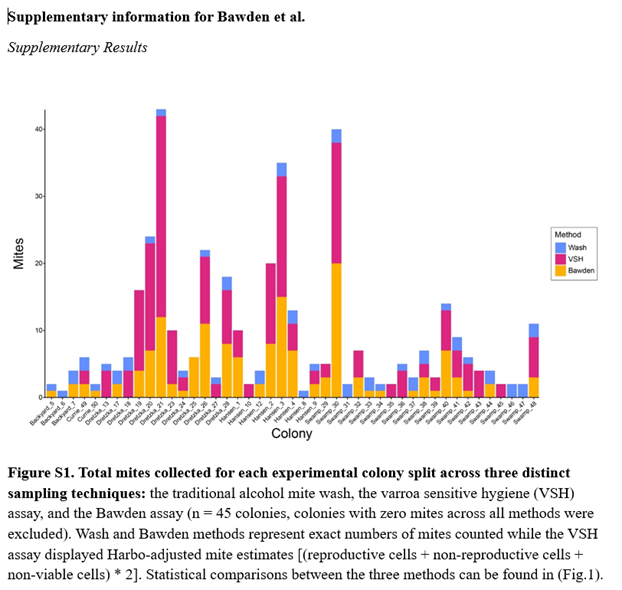
The most widely used mite sampling method among beekeepers is the traditional alcohol wash. The missing piece in this method is that it only samples mites in the dispersal phase on the bees, not mites developing in the capped brood. It is well known that varroa prefer to stay within a brood cell and multiply rather than be vulnerable on a bee. Because of this, the traditional alcohol wash underrepresents the varroa load in the colony. Using the Bawden assay, we sample approximately 200 capped brood cells in the purple-eye-tan-body stage or older, using a faster novel protocol. This allows the beekeeper to accurately determine the current varroa load in the colony. Compared with the traditional alcohol wash, the Bawden assay found a significant difference in the number of mites collected per sample. Beekeepers can use this new method to accurately monitor their varroa loads and determine the efficacy of their mite treatments with much greater reliability. One further benefit is that the chances of the beekeeper killing their queen during the assay are greatly diminished, since all the bees must be removed first before the assay can take place.
Using the Bawden assay as a VSH queen breeding tool for mite resistance
The Harbo VSH assay is a well-established method that involves sampling 200 capped brood cells with purple eyes, tan bodies, or older pupae and inspecting them for varroa. It is a rigorous process that requires uncapping each cell individually, specialized equipment, and significant training to perform correctly.
The Bawden Assay follows the same core sampling process while streamlining several of the more resource-intensive steps. Equipment costs and time investment are notably lower than those of the Harbo VSH assay, making consistent breeder selection more accessible across a wider range of operations.
Field data collected by Trevor Bawden and his team found no statistically significant difference in accuracy between the two methods for assessing varroa counts in capped broods and predicting breeding potential. The Bawden Assay offers beekeepers comparable precision at a lower barrier to entry.
The Bawden Assay can be used to screen a yard of 50 colonies for VSH mite resistance in an afternoon, compared to the days it would take with the Harbo VSH assay. We recommend using this tool as a prescreening step for breeder queen selection in your yards. Once this screening is complete, the user can choose to conduct the Harbo VSH assay on the top 10% of colonies that scored the highest. The Harbo VSH assay is the established benchmark for VSH breeding selection. The Bawden Assay builds on that foundation by offering a practical first-screening step — one that requires significantly less time, equipment, and training, while producing no statistically significant difference in accuracy for identifying colonies with mite-resistant breeding potential.

What’s next for the Bawden assay
We have lots of data to share with everyone in the near future once the paper has been published. You will be able to find a copy of the publication on this website at that time. Please check back with us and keep an eye out for the announcement of more details via our newsletter. You can subscribe to our newsletter by scrolling down to the bottom of this page and submitting your email address.
Citation
Martin, S. J. (1998) A population model of the ectoparasitic mite Varroa jacobsoni in honey bee (Apis mellifera) colonies. Ecological Modeling, 109: 267-281
Macedo, P, J Wu & M Ellis (2002) Using inert dusts to detect and assess varroa
infestations in honey bee colonies, Journal of Apicultural Research, 41(1-2): 3-7
Stolbov, N. M., Vasikov, N. A. 1976. An apparatus for discovering the varroa mite.
Pchelovodstvo (8): 17 (In Russian)
De Jong, David, Roger A. Morse, and George C. Eickwort. "Mite pests of honey
bees." Annu. Rev. Entomol 27.1 (1982): 229-252.
Harbo, J. R., R. A. Hoopingarner, and J. W. Harris. "Evaluating honey bees for
resistance to varroa mites: procedures and results." (1997): 223-224.


Comments